










Induction Generator vs Synchronous Generator - What Do You Want to Know?
The first step in selecting any generator is to define its power conversion type: will it produce AC power, or DC power? This splits generator options into two main categories, AC generators and DC generators, and eliminates any generator models incompatible with your power output requirements. However, both categories still contain many types of machines, so this article will focus on differentiating the AC generator category. AC generators can be divided into synchronous generators and induction generators. This article briefly describes both types and compares their operating characteristics and typical applications.
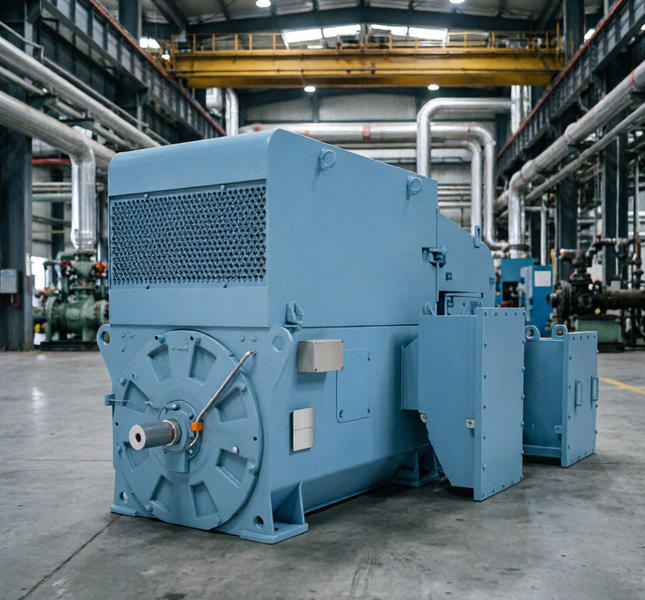
Induction generators are among the most widely used AC generators for industrial power generation today. Derived from one of the earliest invented electrical machines, they have undergone decades of optimization for diverse generation scenarios. They feature a relatively simple structure, consisting of an outer stator and an inner rotor. Driven by a prime mover, the machine converts mechanical energy into electrical energy via electromagnetic induction.
Different types of induction generators achieve power generation with slight variations, but the general working principle is consistent. The prime mover drives the rotor to rotate faster than the synchronous speed. A rotating magnetic field forms in the stator, and this field induces a magnetic field in the rotor. The relative motion between the rotor and the rotating magnetic field generates induced current in the stator windings and outputs usable AC power. Induction generators are also known as asynchronous generators because the actual rotor speed does not directly match the synchronous speed of the AC output. This phenomenon is called "slip". For generator operation, slip becomes negative as the rotor runs above synchronous speed. The presence of slip means induction generators cannot maintain perfectly fixed frequency under variable load or prime mover speed. As mentioned earlier, these generators are widely adopted for small hydroelectric, wind power, and decentralized industrial power generation. They are available in many power ratings, voltage levels, sizes and configurations.
Synchronous Generators
Synchronous generators fill the performance gaps of induction generators, especially regarding the asynchronous operating feature. Their output AC frequency precisely matches the rotor’s mechanical rotational frequency. This characteristic allows engineers to deploy synchronous generators for applications requiring stable, precise frequency and voltage output, such as large power plants, backup grid power, rolling mill power supply, and critical industrial standby power. They achieve this stable output by matching the magnetic poles of the stator and rotor. When the rotor with DC excitation is driven at synchronous speed, the rotating rotor magnetic field cuts stator windings and produces AC power with strictly synchronized frequency.
Synchronous generators need an independent DC excitation system to establish the rotor magnetic field. In most cases, external excitation equipment or an auxiliary exciter is required to build up the rotor magnetic field before power generation. Unlike induction generators, which can build up power with capacitor banks or grid reactive power, synchronous generators rely on dedicated excitation control. In addition, although synchronous generators maintain fixed frequency at rated speed, adjusting their output power and voltage requires automatic voltage regulators and control systems. Synchronous generators usually carry higher procurement costs than induction generators, yet they deliver superior power factor control and stable voltage performance. They are the preferred option for large thermal power, hydropower stations, and heavy-duty standalone power generation with strict power quality requirements.
The simple construction of induction generators is their biggest advantage over synchronous generator designs. They are easy to manufacture, operate and maintain, which explains why induction generators cost much less than synchronous generators. On the contrary, synchronous generators require more complex rotor assemblies. Their rotor components are harder to produce and maintain, and extra excitation circuitry and control cabinets must be purchased and installed to guarantee stable power output.
As introduced above, induction generators can operate with simpler auxiliary setups, while synchronous generators need supporting excitation systems. This means induction generators need fewer peripheral devices to operate reliably, cutting overall system cost and complexity.
Power density refers to the electrical power output per unit of generator volume. Synchronous generators generally offer higher power density than induction generators of identical physical size. They can deliver larger power output within a smaller footprint, making them ideal for projects with limited installation space. This is a key reason engineers select synchronous generators over induction generators.
Under proper design conditions, synchronous generators can reach efficiency above 90% and often achieve better energy efficiency than induction generators. The exact efficiency depends on the generator’s power rating and design. Since synchronous generators operate without slip, less energy loss occurs during the conversion from mechanical energy to electrical energy.
Finally, price difference is a core distinction between induction generators and synchronous generators. For the reasons discussed above, synchronous generators have higher costs in production, system integration, operation and maintenance than induction generators. Nevertheless, their energy-saving performance and flexible power factor correction capability can offset the higher upfront investment. Whether the total cost saving is worthwhile depends on the specific project requirements. Engineers should always evaluate total life cycle cost and aim to minimize it for every power generation project.
Related Posts

NORD UNIVERSAL SMI Worm Gearmotor (Low Voltage)
Jua 27, 2026
NORD MAXXDRIVE® Parallel Gear Unit (Standard Model)
Jua 26, 2026
SIEMENS Industrial Low-Voltage Helical Gearmotor
Jua 26, 2026